

State Verbs
State Verbs
1. General description
Most verbs in English are dynamic. They can describe habits or actions in progress. Dynamic verbs have simple and continuous forms.
Habit: I often travel abroad.
Action in progress: I am watching television at the moment.
State has no beginning or end, they describe states, not actions.
Some verbs are always stative: belong, want
Some verbs can have state or dynamic uses: weigh/weighing
2. Feelings and perceptions
Feelings: Like, love, prefer, hate, dislike, care, hope, admit
Perception: Feel, hear, notice, see, smell, sound, taste
We normally use these verbs in the simple tenses:
Do you see that woman in the park?
I love cats.
We often use can with see, hear , smell and taste:
I can smell something (at the moment)
Can you hear the music?
3. Wants
Wants and needs: want, need, wish, depend on, weigh, come from, cost
I wish you good luck.
The room needs cleaning.
She wants to sleep.
4. Existence and possession
Existence: be, exist
Possession: belong to, own, owe, have, possess
Appearance: appear, seem, resemble, look
She is tall.
Who does this pen belong to?
It appears to be difficult.
5. Thinking and believing
Knowledge: forget, realise, understand, know, remember
Opinion: believe, doubt, imagine, suppose, think, expect, agree, mean, deserve
If we want to say “have an opinion”, we can use think:
I think he is a nice person.
Other examples:
She doesn’t understand your words.
I know Peter well.
I doubt he would like your idea
6. Compositions and connections
Compositions: consist of, contain, have
Connection: come from, concern, cost, fit, suit
The presentation consists of five parts.
Maggie comes from Canada.
My friend has a Ferrari.
7. Change in meaning
Some verbs can have a dynamic or state form with a change in meaning.
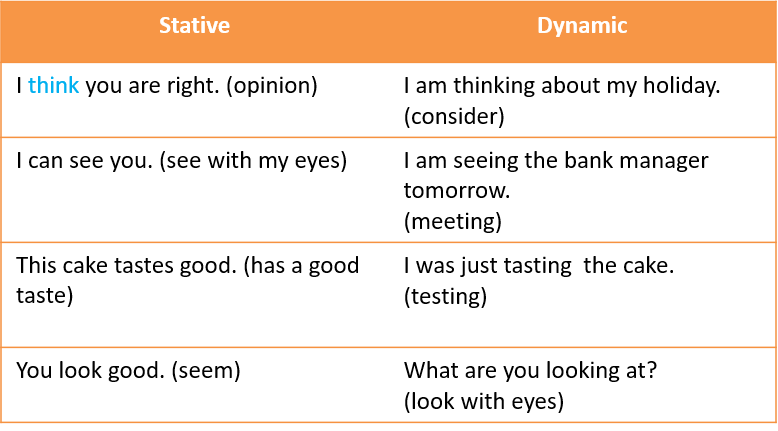
Ready to test your knowledge?
Put the grammar rules above into practice with the challenge below.

