
Modal Verbs
The modal verbs help us express extra ideas that other types of sentences cannot.
- The verb system
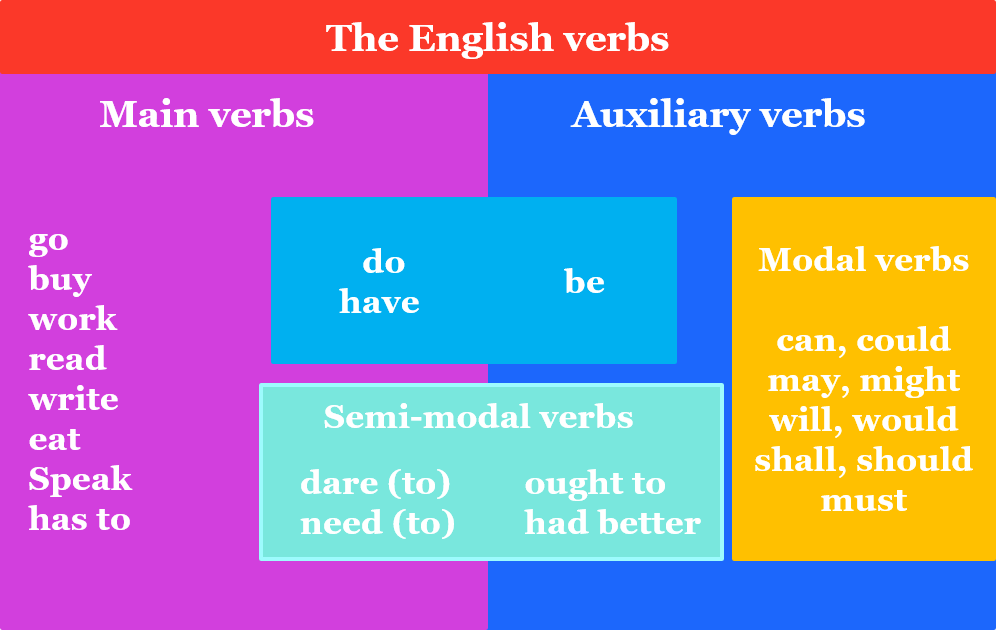
The chart below shows how the different types of verbs are related in the English language.
- What does it mean?
As you could see from the chart before, in the English language we can have main verbs and auxiliary verbs.
Auxiliary verbs help the main verbs to form tenses, negative sentences and questions.
I don’t eat meat. (negative sentence)
I have eaten an apple. (present perfect)
Can you swim? (question)
Modal verbs can give several extra meanings to the main verb:
- Ability: Peter can sing well.
- Obligation: You must pay the bills.
- Permission: You may sit down.
- Prohibition: Dogs mustn’t
- Possibility: He could arrive soon.
- Characteristics
Modal verbs behave differently from main verbs:
- They never change, they don’t add –s, -ed, -ing.
- They are followed by the verb without ‘to’.
- They always go before the main verb.
- They form the negative by adding ‘not’ or ‘n’t’.
- They are used to form questions and negatives.

