

Future Time Clauses
1. What is it?
The part of a sentence which talks about the future is a called future time clause or conjunction of time.
They are introduced by the following conjunctions: 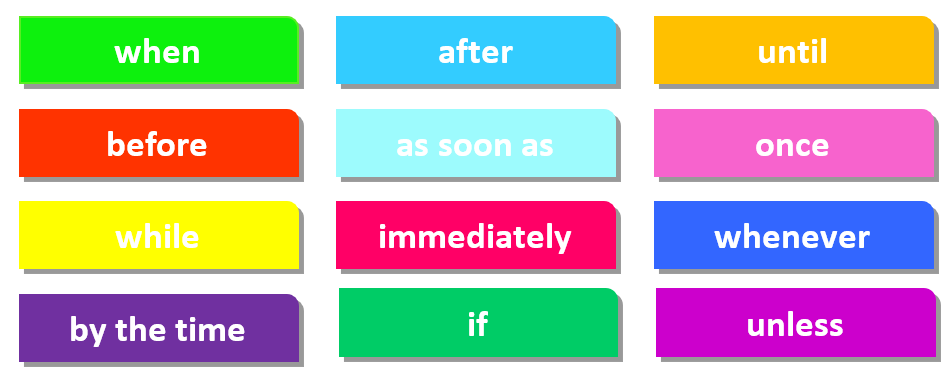
It is also used after any time word that refers to the future: the moment, the minute, the second, till, etc.
2. Use
If time clauses refer to the future, we usually use the present simple or the present perfect after the conjunction.
When I arrive home, I will phone you.
As soon as I have arrived, I will phone you.
I will phone you before I leave the office.
3. Use with present simple
We use the present simple in the future time clause, if the two actions in the sentence happen at the same time or the emphasis is on the action.
When I see her, I will tell her the news. (at the same time)
As soon as I hear something, I will let you know. (immediately I will inform you)
4. Use with present continuous
We use the present continuous in the future time clause
You will find a better job when you are working on your PHD.
5. Use with present perfect
We use the present perfect in future time clauses to show that an action is completed before another action.
I will phone you after I have arrived home. (First I arrive home, then I will phone you.)
As soon as I have finished my studies, I will travel round the world. (First I will finish my studies, then I will travel.)
Often, we can use either the present simple or the present perfect without any change in the meaning.
I will cook dinner when I arrive home.
I will cook dinner when I’ve arrived home.
6. Use with present perfect continuous
We use the present perfect continuous in the future time clause to how long the action has been going on before another action.
You can apply for citizenship once you have been living in the country for 10 years.
7. Use with “if”
In conditional sentences, we normally use the present simple after if.
If it rains, I will stay at home.
8. “If” or “when”?
We use “if” to express possibility. We use “when” to express certainty.
Compare:
If it rains, I will stay at home. (It is possible that it will rain so in that case, I will stay at home.)
When it rains, I always stay at home. (It is my habit.)
Ready to test your knowledge?
Put the grammar rules above into practice with the challenge below.

