
Prepositions of Place and Movement
1. Use of ‘in, at, on’
| in | at | on |
| refers to an area or volume | refers to a point, place or event | refers to a surface |
| in the building
in Europe / Asia in London in New York in the garden in the park in the street in the room in bed in hospital in prison in church |
at the airport
at the bus stop at the bank at the library at home at church at school at a concert at a dinner at a meeting at a party at (address) |
on the wall
on the screen on the window on the floor on the door on a page on a sheet of paper on the bed on the ceiling on the ground on the grass on the beach |
| in a queue
in a row in a line in the sky in the world in the country in the photograph in a book in a magazine in a newspaper in the world in the corner |
at the top
at the bottom at the end at the back at the front at the corner at sea at work at college at university at a dance at a wedding |
on the right
on the left on the left-hand side on the right-hand side on a menu on a list on the ground floor on the first floor on a river on the river Thames on the way on a bus/plane on the train/ship |
2. The use of ‘beside, besides, by’
| besides | ‘in addition, as well as, except’
Jack was at the party besides Frank and Sally. |
| ‘except’
He invited everyone to his birthday party besides me! |
|
| beside | ‘next to’
Our house is beside /by the post office. |
| by | ‘next to’
Our house is beside /by the post office. |
| ‘beyond, past an area or object’
My friend went right by me yesterday without saying hello. |
|
| ‘using a vehicle’
Jack commutes to work by car. |
|
| ‘right next to, close’
The hotel is right by the airport |
3. The use of ‘between/among’ and ‘like/as’
between between two people
among among more than two people
like means ‘similar to’
as ‘in the role of, function’
My room is between the kitchen and the living room.
The teacher divided the sweets among the students.
Phil works like a machine! (=he similarly to a machine, perhaps fast, precise, etc)
My sister works as an accountant. (=she is an accountant
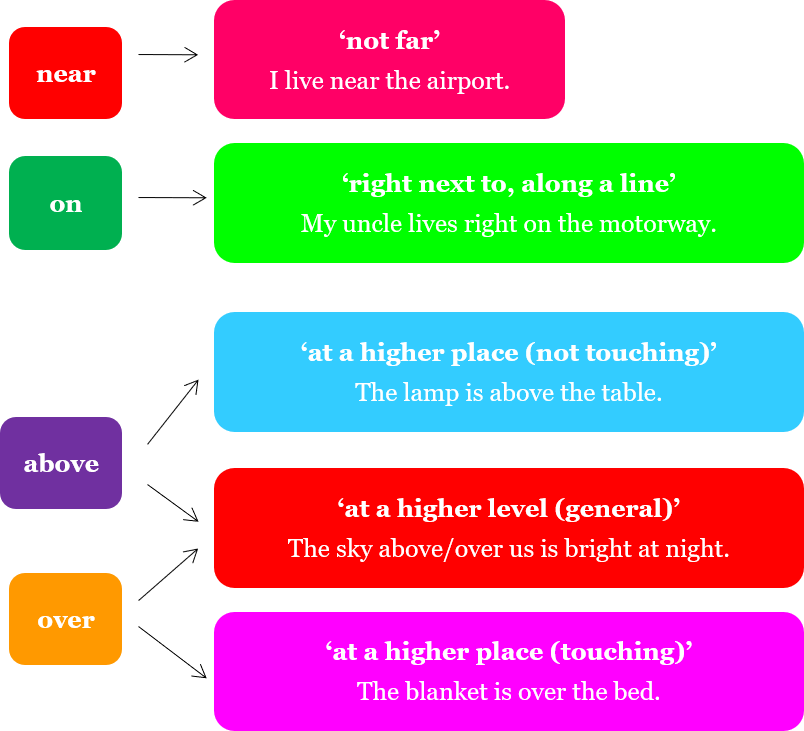
4. The use of ‘near/on’ and ‘above/over
Ready to test your knowledge?
Put the grammar rules above into practice with the challenge below.