

• Link to Facebook
  • Link to Instagram
  • Link to Pinterest
  • Link to LinkedIn
  • Link to WhatsApp
  • Link to Youtube
  • Register
  • Log in
Specialising in Business English for the European Workplace
Professional English Materials
  • Teacher Tools
  • Grammar Lab
    • Adjectives and Adverbs
    • Articles
    • Conditionals
    • Linking Words
    • Nouns
    • Passive Constructions
    • Prepositions
    • Pronouns and Determiners
    • Questions
    • Relative Clauses
    • Reported Speech
    • Spelling and Punctuation
    • Tenses
      • Future Tenses
      • Past Tenses
      • Present Tenses
    • Verbs
      • Gerund or Infinitive
      • Irregular Verbs
      • Modal Verbs
      • Verb Patterns
  • Menu Menu

Future Time Clauses

1. What is it?

The part of a sentence which talks about the future is a called future time clause or conjunction of time.

They are introduced by the following conjunctions:
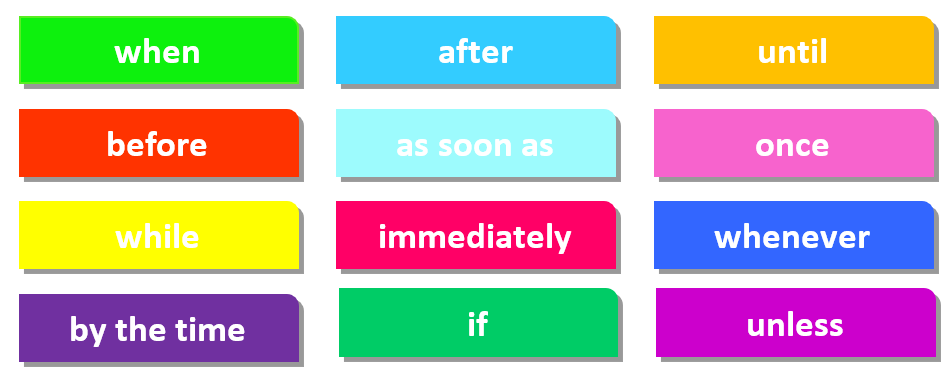
It is also used after any time word that refers to the future: the moment, the minute, the second, till, etc.

2. Use

If time clauses refer to the future, we usually use the present simple or the present perfect after the conjunction.

When I arrive home, I will phone you.

As soon as I have arrived, I will phone you.

I will phone you before I leave the office.

3. Use with present simple

We use the present simple in the future time clause, if the two actions in the sentence happen at the same time or the emphasis is on the action.

When I see her, I will tell her the news. (at the same time)

As soon as I hear something, I will let you know. (immediately I will inform you)

4. Use with present continuous

We use the present continuous in the future time clause

You will find a better job when you are working on your PHD.

5. Use with present perfect

We use the present perfect in future time clauses to show that an action is completed before another action.

I will phone you after I have arrived home. (First I arrive home, then I will phone you.)

As soon as I have finished my studies, I will travel round the world. (First I will finish my studies, then I will travel.)

Often, we can use either the present simple or the present perfect without any change in the meaning.

I will cook dinner when I arrive home.

I will cook dinner when I’ve arrived home.

6. Use with present perfect continuous

We use the present perfect continuous in the future time clause to how long the action has been going on before another action.

You can apply for citizenship once you have been living in the country for 10 years.

7. Use with “if”

In conditional sentences, we normally use the present simple after if.

If it rains, I will stay at home.

8. “If” or “when”?

We use “if” to express possibility. We use “when” to express certainty.

Compare:

If it rains, I will stay at home. (It is possible that it will rain so in that case, I will stay at home.)

When it rains, I always stay at home. (It is my habit.)

Ready to test your knowledge?

Put the grammar rules above into practice with the challenge below.

Future Time Clauses Challenge
⏱ 00:00
❤️ ❤️ ❤️
SCORE: 0
📝
Future Time Clauses Challenge
Practice using present tenses after conjunctions like "when", "as soon as", "before", and "after" to talk about the future.
💼 Workplace Context 📖 Time Clauses 2 Levels · 14 Questions ❤️❤️❤️ 3 Lives
Complete the sentences using the correct tense or conjunction.
Level 1 — Fill in the blank
WORD BANK
    Drag the correct words into the empty spaces.
    Level 2 — Drag & Drop
      WORD BANK
      🏆
      Challenge Complete!
      Well done on finishing both levels.
      0
      points out of 14
      Your Answers
      Copied to clipboard! 📋

      Grammar Lab

      • Adjectives and Adverbs
      • Articles
      • Conditionals
      • Linking Words
      • Nouns
      • Passive Constructions
      • Prepositions
      • Pronouns and Determiners
      • Questions
      • Relative Clauses
      • Reported Speech
      • Spelling and Punctuation
      • Tenses
        • Future Tenses
        • Past Tenses
        • Present Tenses
      • Verbs
        • Gerund or Infinitive
        • Irregular Verbs
        • Modal Verbs
        • Verb Patterns
      • Checkout
      • Products
      • Home landing new

      Professional English

      Madrid

      Spain

      Opening Hours

      Monday           07:00–23:00
      Tuesday           07:00–23:00
      Wednesday     07:00–23:00
      Thursday         07:00–23:00
      Friday              07:00–23:00
      Saturday          08:00–17:00
      Sunday            Closed

      © Copyright - English for Professionals Materials
      • Link to Facebook
      • Link to Instagram
      • Link to Pinterest
      • Link to LinkedIn
      • Link to WhatsApp
      • Link to Youtube
      • Terms and Conditions
      • Terms of Service
      • Privacy Policy and Data Protection
      • Acknowledgement
      Link to: The Mixed Conditional Link to: The Mixed Conditional The Mixed Conditional Link to: The Second Conditional Link to: The Second Conditional The Second Conditional
      Scroll to top Scroll to top Scroll to top

      This site uses cookies. By continuing to browse the site, you are agreeing to our use of cookies.

      AcceptDo not acceptSettings

      Cookie and Privacy Settings


      How we use cookies

      We may request cookies to be set on your device. We use cookies to let us know when you visit our websites, how you interact with us, to enrich your user experience, and to customize your relationship with our website.

      Click on the different category headings to find out more. You can also change some of your preferences. Note that blocking some types of cookies may impact your experience on our websites and the services we are able to offer.

      Essential Website Cookies

      These cookies are strictly necessary to provide you with services available through our website and to use some of its features.

      Because these cookies are strictly necessary to deliver the website, refusing them will have impact how our site functions. You always can block or delete cookies by changing your browser settings and force blocking all cookies on this website. But this will always prompt you to accept/refuse cookies when revisiting our site.

      We fully respect if you want to refuse cookies but to avoid asking you again and again kindly allow us to store a cookie for that. You are free to opt out any time or opt in for other cookies to get a better experience. If you refuse cookies we will remove all set cookies in our domain.

      We provide you with a list of stored cookies on your computer in our domain so you can check what we stored. Due to security reasons we are not able to show or modify cookies from other domains. You can check these in your browser security settings.

      Other external services

      We also use different external services like Google Webfonts, Google Maps, and external Video providers. Since these providers may collect personal data like your IP address we allow you to block them here. Please be aware that this might heavily reduce the functionality and appearance of our site. Changes will take effect once you reload the page.

      Google Webfont Settings:

      Google Map Settings:

      Google reCaptcha Settings:

      Vimeo and Youtube video embeds:

      Privacy Policy

      You can read about our cookies and privacy settings in detail on our Privacy Policy Page.

      Privacy Policy and Data Protection
      Open Message Bar Open Message Bar Open Message Bar