

• Login
ProfEnglish
  • Lessons
  • Teacher Tools
    • Wheel of Names
    • Wheel of Fortune
    • Classroom Timer
    • Business News Generator with Feedback
    • Topic Generator
    • Speaking Practice Lab
    • End-of-Lesson Summary
    • Lesson Focus Justifier
  • Grammar Lab
    • Adjectives and Adverbs
    • Articles
    • Conditionals
    • Linking Words
    • Nouns
    • Passive Constructions
    • Prepositions
    • Pronouns and Determiners
    • Questions
    • Relative Clauses
    • Reported Speech
    • Spelling and Punctuation
    • Tenses
      • Future Tenses
      • Past Tenses
      • Present Tenses
    • Verbs
      • Gerund or Infinitive
      • Irregular Verbs
      • Modal Verbs
  • Price
  • Menu Menu

The Present Perfect

The Present Perfect

1. Relationship between past and present

We use the present perfect when:

a) there is a connection between the past and the present:

I have read this book. (so I know it)

b) we give new information:

I have broken the vase. (so it is broken)

) to talk about things people have done or experienced and the exact time is not important and the action can be repeated:

He has travelled to several countries. (not important when)

2. With adverbials

We use the present perfect with adverbials which show a connection between the past and the present:

already, yet, still, just, so far, up to now, ever, never, recently, since, for, ever, before, etc.

I have already finished the project.

Peter has lived in London and New York so far.

She has just completed her degree.

Have you ever been to New York?

I have never eaten a frog.

3. With time reference

We use the present perfect to talk about a period of time which started in the past and continuing into the present (and perhaps beyond).

We often use: today, this + morning/afternoon/week/year, etc.

I ’ve travelled a lot. (in my life and can do it again)

I have taken two exams this week. (the week is not finished)

She has written three emails this morning. (the morning is not finished)

4. In clauses of time and condition

We use the present perfect simple to refer to a future action which will be completed.

I will send you an email after I have finished my homework.

Can you give me a ring when you have arrived to the hotel?

Once you have found your passport, you can travel again.

5. With since, for, how long

We use the present perfect simple to describe how long an activity is if the activity started in the past and continues to the present or into the future.

We use: since, for and how long


I have lived in Beijing for 6 months.

He has worked for Microsoft since 1996.

How long have you had this car?

6. With superlatives

We can use the present perfect simple with superlatives to say that something we experience is the best/worst, first, etc that has happened to us so far.

It’s the best cake I have ever eaten.

It’s the most expensive holiday I have ever had.

It’s the first time I have been here.

7. For or since?

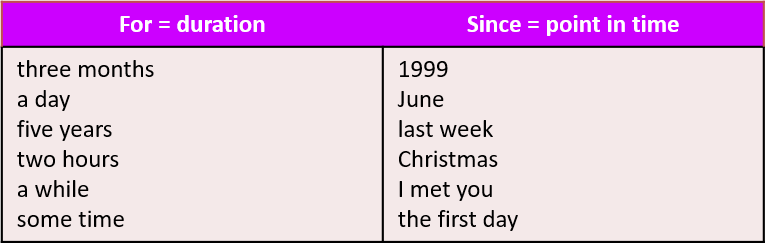
We use for to say how long an activity is (a period of time). We use since to say when an activity started.
Ready to test your knowledge?

Put the grammar rules above into practice with the challenge below.

⏱ 00:00
❤️ ❤️ ❤️
SCORE: 0
📝
Present Perfect Challenge
Practice using the present perfect for past connections, experiences, and time clauses. Complete two levels — fill in the blanks, then a drag & drop challenge.
🎯 Grammar Practice 📖 Present Perfect 2 Levels · 14 Questions ❤️❤️❤️ 3 Lives
Complete the sentences using the correct present perfect verb. Use the correct form of the verb.
Level 1 — Fill in the blank
WORD BANK
    Drag the correct words into the empty spaces.
    Level 2 — Drag & Drop
      WORD BANK
      🏆
      Challenge Complete!
      Well done on finishing both levels.
      0
      points out of 14
      Your Answers
      Copied to clipboard! 📋

      Grammar Lab

      • Adjectives and Adverbs
      • Articles
      • Conditionals
      • Linking Words
      • Nouns
      • Passive Constructions
      • Prepositions
      • Pronouns and Determiners
      • Questions
      • Relative Clauses
      • Reported Speech
      • Spelling and Punctuation
      • Tenses
        • Future Tenses
        • Past Tenses
        • Present Tenses
      • Verbs
        • Gerund or Infinitive
        • Irregular Verbs
        • Modal Verbs
        • Verb Patterns
      © Copyright - ProfEnglish Materials
      • Link to Facebook
      • Link to Instagram
      • Link to Pinterest
      • Link to LinkedIn
      • Link to WhatsApp
      • Link to Youtube
      • Aviso Legal
      • GDPR Privacy Policy
      • Cookie Policy
      • Terms and Conditions
      • Refund Policy
      Link to: The Present Perfect Continuous Link to: The Present Perfect Continuous The Present Perfect Continuous Link to: Ways to Talk About The Future Link to: Ways to Talk About The Future Ways to Talk About The Future
      Scroll to top Scroll to top Scroll to top
      Manage Consent
      To provide the best experiences, we use technologies like cookies to store and/or access device information. Consenting to these technologies will allow us to process data such as browsing behaviour or unique IDs on this site. Not consenting or withdrawing consent, may adversely affect certain features and functions.
      Functional Always active
      The technical storage or access is strictly necessary for the legitimate purpose of enabling the use of a specific service explicitly requested by the subscriber or user, or for the sole purpose of carrying out the transmission of a communication over an electronic communications network.
      Preferences
      The technical storage or access is necessary for the legitimate purpose of storing preferences that are not requested by the subscriber or user.
      Statistics
      The technical storage or access that is used exclusively for statistical purposes. The technical storage or access that is used exclusively for anonymous statistical purposes. Without a subpoena, voluntary compliance on the part of your Internet Service Provider, or additional records from a third party, information stored or retrieved for this purpose alone cannot usually be used to identify you.
      Marketing
      The technical storage or access is required to create user profiles to send advertising, or to track the user on a website or across several websites for similar marketing purposes.
      • Manage options
      • Manage services
      • Manage {vendor_count} vendors
      • Read more about these purposes
      View preferences
      • {title}
      • {title}
      • {title}